The Central Teaching of the Yoga Sūtra, explored
through study, reflection and meditation
YOGA = SAMĀDHI
Patañjali defines yoga as samādhi - a special state of mind, which happens when mental activity stops.
It is associated with a profound feeling of peace, clarity and bliss (sat-cit-ānanda).
Patañjali continues by saying, that when the mind is in this state - consciousness (the Self/our true nature) is experienced in its pure (true/unconditioned) form.
Whereas, when the mind moves, it seems as though consciousness moves with, or is modified by it.
It is generally assumed that such states of yoga are not accessible to ordinary people, but yogis suggest that Samādhi is a natural phenomenon that all human beings are able to experience.
In fact, they assert, a human being should experience Samādhi on a regular basis: it is just as important for our good health, as the three other natural states of consciousness - the waking, dreaming and deep sleep states.
According to yogis, every human being experiences Samādhi in utero. We have a dim memory of this deep state of peace and bliss, and our drive to satisfy desire or to avoid discomfort in life is nothing but the craving to recover this natural state of peace.
The bliss of Samādhi is accessible through yoga practices, and cultivating this is a central theme of our course.
TEACHING METHODOLOGY
“Yoga is the practical field of knowledge” - Śrī BNS Iyengar
Kṛṣṇamācārya and his students were critical of book learning - they used to point out that you cannot understand yoga just through reading about it, you can only properly understand it through practice.
Just as the study of cookery will not provide one with delicious and nourishing food, unless you also actually cook and eat your meal, the study of yoga will not produce any desired results without reflection and practice.
Yoga makes no sense without practice: one cannot understand or appreciate it abstractly. It only makes sense through experience. This applies equally to āsana, prāṇāyāma, meditation and using the analytical mind (viveka/discrimination).
A Transformational Journey
While the “state of yoga” is known as samādhi, the practice of yoga, which is required if the state of yoga/samādhi does not happen naturally, must be something that changes us. Yoga is a transformative practice.
Exploring yoga philosophy is a practice that should transform the mind, just as āsana practice transforms the body. And this transformation is necessary because the subtle truth cannot be grasped intellectually.
By definition, samādhi happens when the mind stops. If the mind has stopped, what can be said about our experience? How can one speak about or conceptualise such experiences (if there are no thoughts/feelings/perceptions)?
So words cannot describe samādhi, they can only point us in a certain direction. After that, one has to meditate on what those words are indicating in order for the meaning/understanding to sink in.
A Three Part Process
For this purpose we apply a timeless three part methodology, first described in the Bṛhadāraṇyaka Upaniṣad, which involves first hearing about the truth, then reflecting on what one has heard and finally understanding the truth in depth through meditation.
आत्मा वा अरे द्रष्टव्यः श्रोतव्यो मन्तव्यो निदिध्यासितव्यः ।
ātmā vā are draṣṭavyaḥ śrotavyo mantavyo nididhyāsitavyaḥ
“To see the Self (ātmā) you should hear the exalted truth, reflect on it and then meditate on your reflections”
- Bṛhadāraṇyaka Upaniṣad 2.4.5
This is the method we will follow.
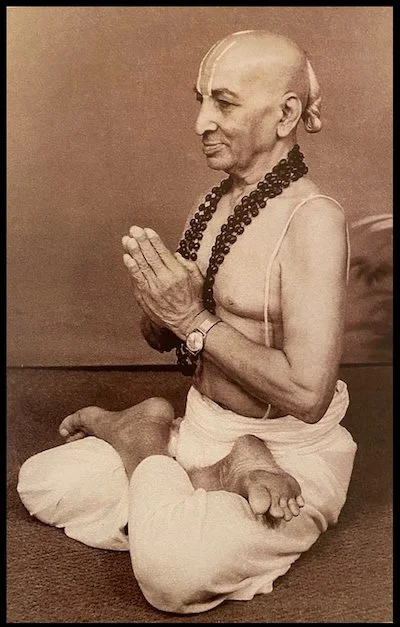
T Kṛṣṇamācārya
COURSE STRUCTURE
This eight month course is subdivided into the study of the four "pādas” (chapters) of the Yoga Sūtra (Samādhi, Sādhana, Vibhūti and Kaivalya Pādas). We will dedicate around two months to each of the first two chapters, with a one month break between. Then the third and fourth chapters, which are shorter and have less commentary, will be taught together over a 10 week period.
The Yoga Darśana, which is represented by Patañjali’s teaching, is one of six systems of Indian philosophy, all of which base their teaching on the Vedas. Other Darśanas include Sāṃkhya and Advaita Vedānta - two world views that we shall explore in some depth.
Yoga emerged alongside these other systems of philosophy and our sūtra study will be complemented and enhanced by exploring some of these other sources.
Each week we will explore one section of the Sūtras in depth, looking at important commentaries and then we will also look at another text that can shine more light on our studies.
Two lectures will be recorded per week - one will be a commentary on 4-5 sūtras, the other will be a talk based on a relevant essential reading from one of these texts.
Students will have access to source texts and will be guided by several questions to research deeper. Then we shall meet on Saturday to discuss. After discussion we will set aside time for prāṇāyāma and meditation.
We will focus on the original Yoga Sūtra commentary of Vyāsa and on that of Hariharānanda Āraṇya. I will also share my own reflections based on my studies with various teachers in India, mainly from my studies with Dr KL Śaṅkaranārāyaṇa Jois.
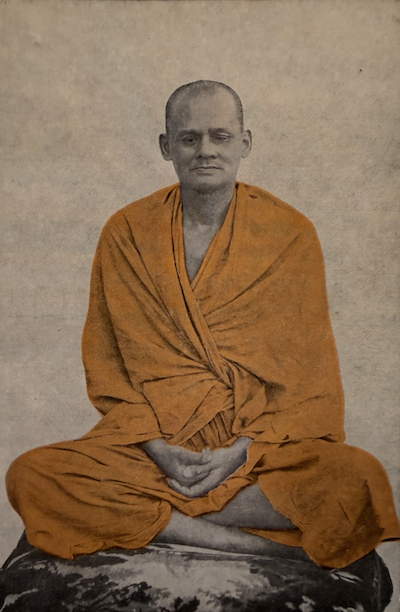
Hariharānanda Āraṇya
SCHEDULE DETAILS
This eight month study includes:
28 recorded talks on the Yoga Sūtra (average 75 min each)
28 recorded talks on the Supplementary Texts (average 60 min each)
28 live meetings (recorded for review) to discuss the texts/practice prāṇāyāma and meditation (2hrs Saturdays)
Yoga Sūtra Text including Vyāsa’s Commentary, digital copies of the supportive texts, where available
LIVE SCHEDULE *
Saturdays
2 PM London
9 AM New York
* All Classes are Recorded for Review
DATES
Samādhi Pāda - December 5 - January 30
Sādhana Pāda - February 27 - April 24
Vibhūti and Kaivalya Pāda - May 29 - July 31
COURSE FEES
ONE-TIME FULL PAYMENT
€2415
EARLY BIRD (before November 1)
€2175
BY PADA (3 instalments)
€865 × 3
MONTHLY INSTALMENTS
€340 × 8
if you would like to support someone else joining the course who cannot otherwise afford it you are invited to make a donation below
in case of financial hardship, please enquire about scholarships
~
special rates are available for groups, teachers and yoga studios
ABOUT MY STUDIES
Having become disillusioned by Western academia, I travelled to South India in the early 90s, to study yoga in a traditional setting. I fell in love with Mysore, which became a second home, and I returned so many times that I lost count.
The approach to study was very different. We would sit on a simple stone floor with the teacher, a small group - often only 5-6 students, and we would go through a text - say the Yoga Sutra - one verse at a time until the whole text was finished.
I was privileged to study with some wonderful teachers, the most important of whom, Dr KL Śaṅkaranārāyaṇa Jois (Ācārya) has been my guide on the path of yoga for over 35 years.
Over the years I studied many texts with him - Yoga Sūtra numerous times, Haṭha Pradīpikā, Gheraṇḍa Saṃhitā, Upaniṣads, Gītā, Sāṃkhya, the Epics etc..
My first teacher, Pattabhi Jois would always say:
“If you want to understand yoga in depth, you have to study the Yoga Sūtra!”
Considering Ashtanga Yoga to be an integral teaching of the Sūtra, I took this message to heart and for the first decade of my practice I dedicated nearly all my study time to this project…
I read every translation, every commentary, attended every seminar… eventually I was moved to study Sanskrit and make my own translation and dedicate time to chanting the Sūtra every day.
At some point I came across a most wonderful translation and commentary—that of Hariharānanda Āraṇya. It is still the source of inspiration more than thirty years later and will form a central part of the course.
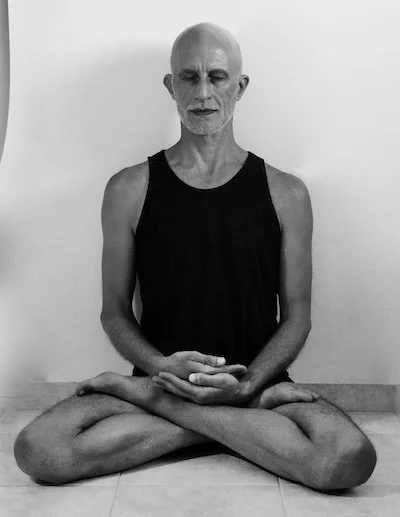
The most important insight I gained from teachers in India is that this experience of Samādhi is a natural phenomenon which is accessible when the conditions are right.
Our intention is to use the text to get deeper and fuller understanding about the nature of this sublime state, which through reflection and meditation can lead towards the cultivation of experience.
We will look at the original text, then by exploring several important commentaries, reflect on it and then conclude all our classes with prāṇāyāma and meditation on our reflections.
~
“The wise should always be one with that silence wherefrom words together with the mind turn back without reaching it, but which is attainable by the Yogins.”
Śaṅkarācārya - Aparokṣānubhūtiḥ
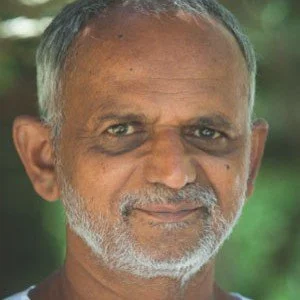
My Teacher - Dr KL Śaṅkaranārāyaṇa Jois
SUTRA STUDY
The Yoga Sūtra, which is 195 verses, around 1250 words or three pages of text, is written in a condensed form. The meaning of the text is thus not immediately obvious without explanation.
There is a huge tradition of commentary on the Sūtra. There are 28 Sanskrit commentaries and countless modern interpretations running into millions of pages…
With so much written about the Yoga Sūtra, how do we know where to look for an authentic interpretation?
COMMENTARIES
We will focus on the first Yoga Sūtra commentary of Vyāsa and on that of Hariharānanda Āraṇya. I will also share my own reflections based on my studies with various teachers in India, mainly from my studies with Dr KL Śaṅkaranārāyaṇa Jois.
It is my intention to extract the essential teachings required for our study of Samādhi and avoid getting bogged down in details which are a distraction to this purpose.
-
The first known commentary on the Yoga Sūtra is called the Vyāsa Bhāṣya. This commentary takes a Sāṃkhya perspective, which is significant because Sāṃkhya represents the theoretical counterpart to the “classical” yoga Darśana, while yoga is regarded as its practical counterpart.
“The state attained by the Sāṃkhyas is also attained by the Yogins. He who sees Sāṃkhya and Yoga as one, truly sees.” - Bhagavad Gita 5.5
However, many people have attempted to superimpose their own belief systems on the Sūtra. In fact, all the commentaries take different perspectives, although all the classical ones treat Vyāsa with the utmost respect, regarding him as an original authority, and only aim to clarify or add to what he says.
Vyāsa’s dates are uncertain, but his commentary is made not too long after the composition of the Sūtra. And the fact that the Yoga Sūtra manuscript has never been found without the commentary of Vyāsa, has led some to suggest that the author of the Sūtra and the Vyāsa Bhāṣya are one and the same person. In any case, we will generally regard Vyāsa’s commentary as the first line of interpretation, before we look at what others have written.
-
Āraṇya’s commentary is unique and significant for several reasons. He belonged to an order of Sāṃkhya monks and spent many years immured in silent meditation. Because of his Sāṃkhya perspective his commentary is especially illuminating. Since he was also a deep practitioner spending so many years meditating in isolation, the insights found in his commentaries are particularly profound with regard to prāṇāyāma and meditation, about which he also makes some wonderful practical suggestions.
-
I studied the Sūtra several times with my teacher and will share insights from my notes and memories. Ācārya’s perspective is unique and refreshing, enlightening even.
“Dr. Shankaranarayana Jois is a Sanskrit scholar and orator in the traditional sciences of India including Yoga, Jyotishya, and Ayurveda.
He began studying the Sanskrit language at the age of five. Later he earned qualification as Vidwan in Literary Criticism and Indian Logic, and attended the Maharaja’s Government Sanskrit College in Mysore, India. He earned a MA in Sanskrit, and a PhD in Yoga. Dr. Jois also holds a degree in Hindi and is qualified as Pandit in Kannada, the state language of Karnataka, India.
Through his family lineage, he is deeply knowledgeable and experienced in Vedic Astrology. However, most influential in Dr. Jois’ life has been the teachings of his Eternal teacher, Sriranga Mahaguru (1913-1969), a highly honored Enlightened yogi with deep insight into the Truth behind the original Indian arts and sciences.”

SUTRA CLASS DETAILS
-
1. Yoga = Samādhi
YS 1.1-1.42. Vṛttis - Ways of Knowing
YS 1.5-1.113. Practice and Non-attachment
YS 1.12-1.164. Stages of Samādhi
YS 1.17-1.225. Īśvara Praṇidhāna and the Sacred Syllable OM
YS 1.23-1.296. Obstacles and Solutions
YS 1.30-1.337. Objects for Stabilising the Mind
YS 1.34-1.408. Absorption - with/without Thoughts - Gross and Subtle Objects
YS 1.41-1.449. Subtlety of Objects Culminates in the Un-manifest and Seedless Samādhi
YS 1.45-1.54 -
1. Causes of Suffering and the Means of Overcoming Affliction
YS 2.1-2.112. Karma as Root Cause of Suffering
YS 2.12-2.153. Future Suffering can be Avoided
YS 2.16-2.204. Nature of the Seer - its Isolation through Discrimination
YS 2.21-2.265. Seven Levels of Achievement, Eight Limbs of Yoga
YS 2.27-2.316. Yama and Niyama
YS 2.32-2.457. Āsana and Prāṇāyāma
YS 2.46-2.518. Pratyāhāra
YS 2.52-2.549. Review
-
details to TBA
-
details to TBA
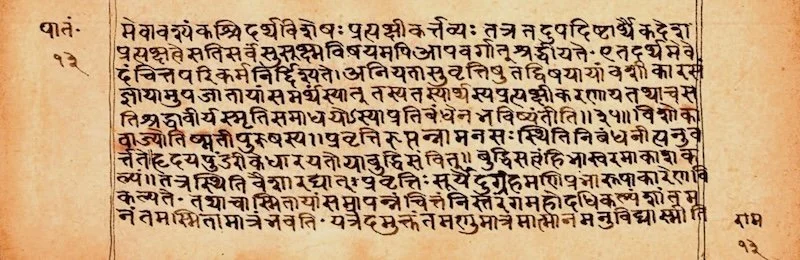
Vyāsa’s commentary on the Yoga Sūtra
SUPPLEMENTARY TEXTS
In order to get a deeper understanding of the Yoga Sūtra, it is valuable to study several other texts, in particular, the Upaniṣads, some of the Haṭha texts, some Advaita texts (Gītā and Ādi Śaṅkarācārya’s works) and a study of the Sāṃkhya system.
In this course we will extract some essential readings from the Bhagavad Gītā, Sāṃkhya Kārikā, Sāṃkhya Sūtra, Kaṭha Upaniṣad, Māṇḍūkya Upaniṣad, Taittirīya Upaniṣad, Yogatārāvalī, Dṛg Dṛśya Viveka, Haṭha Yoga Pradīpikā, Yogayājñavalkya Saṃhitā, Yoga Upaniṣads and more…
Many texts contain significant portions which are of a lesser interest. Our purpose will be to extract the sections with deeper significance, to extract the “juice” or “nectar” from these teachings.
I studied many of these texts with Ācārya. Those texts are often cryptic and are composed in a condensed poetic form. Those studies often simply provided a jumping off point for further or deeper teaching.
So the study of the text detail was not so much our main focus. The unpacking or expanding of what it contained was the interesting part.
Readings from the texts will be in English, without reference to the sanskrit original or in depth commentaries.
These talks will be recorded.

TEXTS INCLUDED
-
The six systems (darśana) of Indian thought all rest their authority on the vedas and particularly on Vedānta, or the Upaniṣads. The Kaṭha Upaniṣad is one of the earliest, and contains some of the earliest examples of yogic thinking.
-
The Taittirīya is particularly valuable for its description of the five bodies (physical, prāṇic, mental, intellectual and bliss bodies) and their relationship to each other.
-
Māṇḍūkya Upaniṣad is devoted to the sacred syllable OM and its relation to the waking, dreaming, deep sleep and transcendental states of awareness. Being only 12 short verses, it doubles as a beautiful meditation on consciousness.
-
There are numerous little-known upaniṣads that give us valuable insights about many aspects of yoga.
-
The BG is one of the most widely read texts in the World, translated into over 100 languages, it is a seminal text on the subject of yoga, seeing it is a practical path of knowledge, as distinct from the theoretical path of Sāṃkhya - though both paths have the same end.
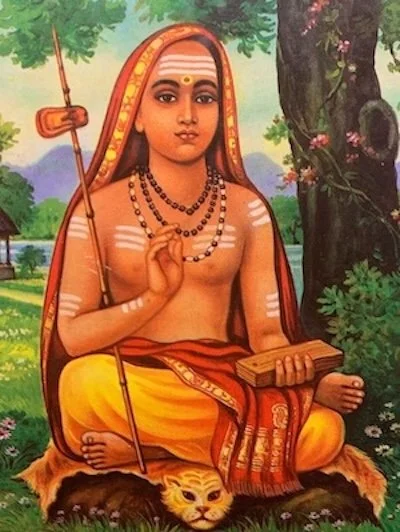
Ādi Śaṅkara
-
Sāṃkhya means enumeration, the means of defining, categorizing and explaining the phenomena of the natural, psychological and spiritual world, as well as the means for emancipation from suffering. The categorization, which includes description of both the phenomenal and the psychological landscape is the underpinning of practically all Indian philosophy.
-
Along with the Yoga Sūtra and the Bhagavad Gītā, the Haṭha Yoga Pradīpikā, is considered one of the most important yogic texts. It is particularly valuable for its description of the nāḍīs, bandhas and prāṇāyāma and the connection between the physical practices and the mental states of meditation.
-
Another very important Haṭha text, though it is one that is not widely known, and one of Kṛṣṇamācārya’s favorites, the YYS is also valuable for its description of the nāḍīs, for an in depth exploration of pratyāhāra and much more.
-
This is the source text for the “Vande Gurūṇām…” mantra. A short treatise on yoga by the great saint Ādi Śaṅkara.
-
Another text from Śaṅkara - a deep meditation on attaining the non-dual state.
-
Who is this course for?
For anyone who wants more from yoga than the physical. Students looking for guidance in the subtler limbs — prāṇāyāma and meditation — and for teaching that is grounded in the tradition rather than in a studio style. Teachers who want to teach from the sources. And anyone who has wondered what samādhi actually is, and whether it is within reach.
Do I need to be experienced in yoga?
No. This study is open to anyone who has interest in yoga and meditation.
Do I need Sanskrit, or a background in philosophy?
No. Every term is explained when it first appears. The readings from the supplementary texts are in English. The Sūtra itself we take slowly — four or five verses a week — with the commentaries doing the unpacking.
What will I actually study?
The Yoga Sūtra of Patañjali, all four chapters, with Vyāsa's commentary and that of Hariharānanda Āraṇya. Alongside it, essential readings from the Upaniṣads, the haṭha texts, Sāṃkhya, and the Advaita of Śaṅkara — chosen for what illuminates the meaning of the Sūtra.
How does the course work week to week?
Two recorded talks — one on the week's sūtras, one on the supplementary reading — with the source texts and a few questions to research. Then a live meeting on Saturday to discuss, followed by prāṇāyāma and meditation.
Is this a philosophy course or a practice course?
Both, and inseparably. Yoga cannot be understood by reading about it — only through practice. Every session ends in prāṇāyāma and meditation on what we have discussed, and the purpose of the whole course is to cultivate the experience the texts describe.
What if I can't attend live?
Every session is recorded and available to you until the end of 2027. The live discussion is where the course comes alive, so attend when you can — but nothing is lost if you can't.
Is there a community?
Yes. Weekly discussion with the same group for eight months — a shared self-study, svādhyāya, undertaken together.
Is there a certificate?
No. This course is for the sincere seeker, not for a credential. (For registered yoga teachers: continuing-education hours can be logged with Yoga Alliance)
-
YOGA SŪTRA
Hariharānanda Āraṇya
These translations are all worth reading:
A Schepers
S Ranganatham
G Feuerstein
E Bryant
A Shearer
BKS Iyengar~
OTHER TEXTS
Bhagavad Gītā
Sāṃkhya Kārikā
Kaṭha Upaniṣad
Māṇḍūkya Upaniṣad
Taittirīya Upaniṣad
Yoga Upaniṣads
Aparokṣānubhūti
Yogatārāvalī
Dṛg Dṛśya Viveka
Haṭha Yoga Pradīpikā
Yogayājñavalkya Saṃhitā